Sheep
The Dog StarsSheep are among the animals sustaining life in the canyon, but their presence also marks what Cima and Hig must leave behind. As the family prepares to depart, they select two lambs to take aboard The Beast. The choice narrows a whole herd and a threatened way of life into a pair small enough to carry, without promising that either the animals left behind or those taken will survive.
The Herd in the Canyon
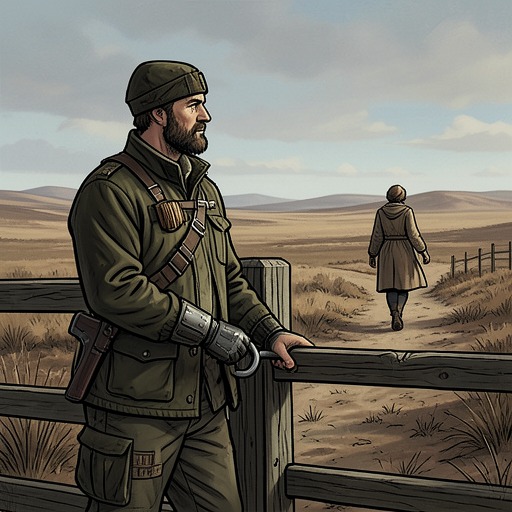
When Hig first surveys the apparently deserted homestead, he sees a few sheep and cattle in the meadow, all facing downstream with their heads lowered. They are rib-thin, with sharply defined hips, and look close to starvation. Their condition makes the canyon’s isolation tangible: the household’s livestock are present, but mere presence is no guarantee of security. The scene also places the animals within a landscape where concealment matters. Hig notices there are no chickens and considers that keeping a rooster might reveal the family’s location. The sheep, by contrast, appear as part of the quieter, less conspicuous life of the settlement.
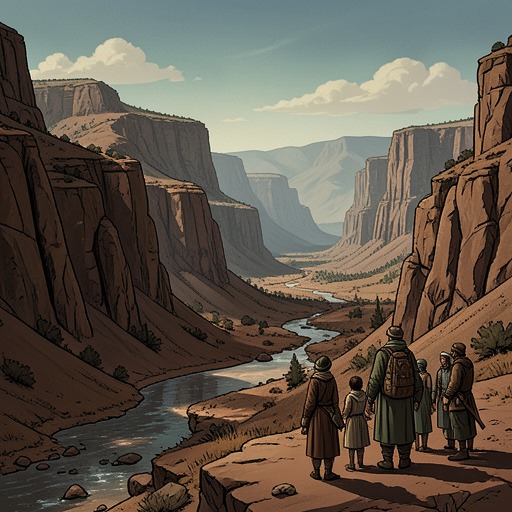
The herd remains part of the family’s daily world as departure approaches. Before leaving, Pops surveys the canyon, including the last pairs of cows and calves and the sheep and lambs, then walks downstream and out through the brush fence. His exit is without ceremony, but it is a break with a life bound to family lineage and the animals raised there. The sheep are not simply supplies to be gathered for the journey: most remain in the meadow as Pops leaves the place he had committed himself to.
Choosing What Can Travel
Hig and Cima cannot take the whole herd in The Beast. They already have roughly twenty pounds of venison, and additional weight would burden an aircraft whose departure depends on careful limits. Cima says the livestock will have to fend for themselves, while hoping that sufficient rain will help them through the season. The plan therefore carries an unresolved cost: leaving the animals preserves the possibility of escape, but their prospects in the canyon remain uncertain.
Cima wants to bring two lambs, one male and one female. Hig first estimates that each might weigh about twenty pounds, but does not rely on the guess. He makes a balance scale beside the stream from a liter bottle, a five-gallon pail, a stick, and rope. The pail gives him a way to weigh the lamb against a known quantity; one lamb, suspended in a sling made from a shirt, balances at about seventeen pounds. This practical test turns the question of whether the animals can come from speculation into a decision based on the aircraft’s capacity. With Pops no longer aboard to complicate takeoff, Hig concludes they can manage the two.
The choice evokes the Ark, but the image is modest rather than triumphant. The pair are a ram and a ewe, and bringing them suggests a chance for continuity; it does not establish what will become of them. The rest of the herd, and the canyon’s uncertain supply of rain, remain outside the aircraft’s protection.
The Departure from the Meadow
The lambs do not leave as neatly as cargo. After spending the night among the animals, Cima helps lead them upstream on twine and up the crude tree ladder beside a small waterfall. Their mothers hear them and follow their cries to the top of the field, confused. The separation makes the cost of the plan immediate: the two chosen lambs are removed from the herd, while their mothers and the rest of the animals remain behind.
Once they reach the higher ground, the lambs stand stiffly on their feet, then follow Hig and Cima. Walking them on strings proves a continuous negotiation. They resist, surge ahead, and make their escorts follow; Hig eventually carries his lamb. The awkward progress briefly distracts the pair from the emotional weight of leaving the canyon. In this sequence, the lambs are not passive symbols: their behavior shapes the pace and labor of the departure, even as the people decide where they can go.
At The Beast, Cima hogties both lambs, and Hig and Cima place them on their packs behind the seats. They strap into their harnesses, and Hig gives Cima the checklist clipboard so she can serve as copilot. The lambs’ journey is thus incorporated into the aircraft’s precise preparations: they are living passengers, but passengers whose size, weight, and handling must fit within a narrow margin.
Significance
The Sheep connect the canyon’s settled life to the uncertain future beyond it. Their thinness and the family’s hope for rain register vulnerability without confirming what will happen to the herd. The departure also distinguishes between the animals who can be carried and those who cannot. Cima’s wish to save a ram and a ewe gives the flight a small element of preservation, while Pops’s departure and the mothers’ unanswered response show what that rescue leaves behind.
The episode’s balance is practical and emotional at once. A homemade scale, a seventeen-pound measurement, the climb beside the waterfall, and the lambs’ placement behind the seats make survival depend on exact physical limits. Yet the animals disrupt the mechanics of escape with their resistance and movement, and their presence turns a departure into a separation. The lambs travel with Hig and Cima; the larger herd remains in the canyon, with its fate left open.